
AI models are growing more capable and more decisions are being outsourced to them. Efficiency and ease of use make it appealing. Why spend thirty minutes thinking when you can get an answer in thirty seconds?
AI is great at processing large amounts of information quickly. It can pull together research, structure data, and model outcomes. These are useful tools to have available as inputs to human decision-making.
But there is one thing it cannot (and should not) do.
It can’t tell you what you want. It can’t tell you why something matters to you. It lacks the ability to understand human motives, deep inner context, and the nuances of human needs. It doesn’t know whether the output actually leads somewhere you care about going.
The typical AI-assisted decision looks something like this. Someone has a problem. They describe it to an AI. The AI gives them options, analysis, and a recommendation. They act on it.
But decisions are not calculations. A decision is an attempt to move you from where you are to where you want to be. The quality of any decision (good or bad) can only be measured against your goals. And your goals are yours.
Getting clear about your goals and values involves comparing things AI can’t. Stability against ambition, relationships against career, your appetite for risk, what feels right.
It means bringing your entire self to a decision.
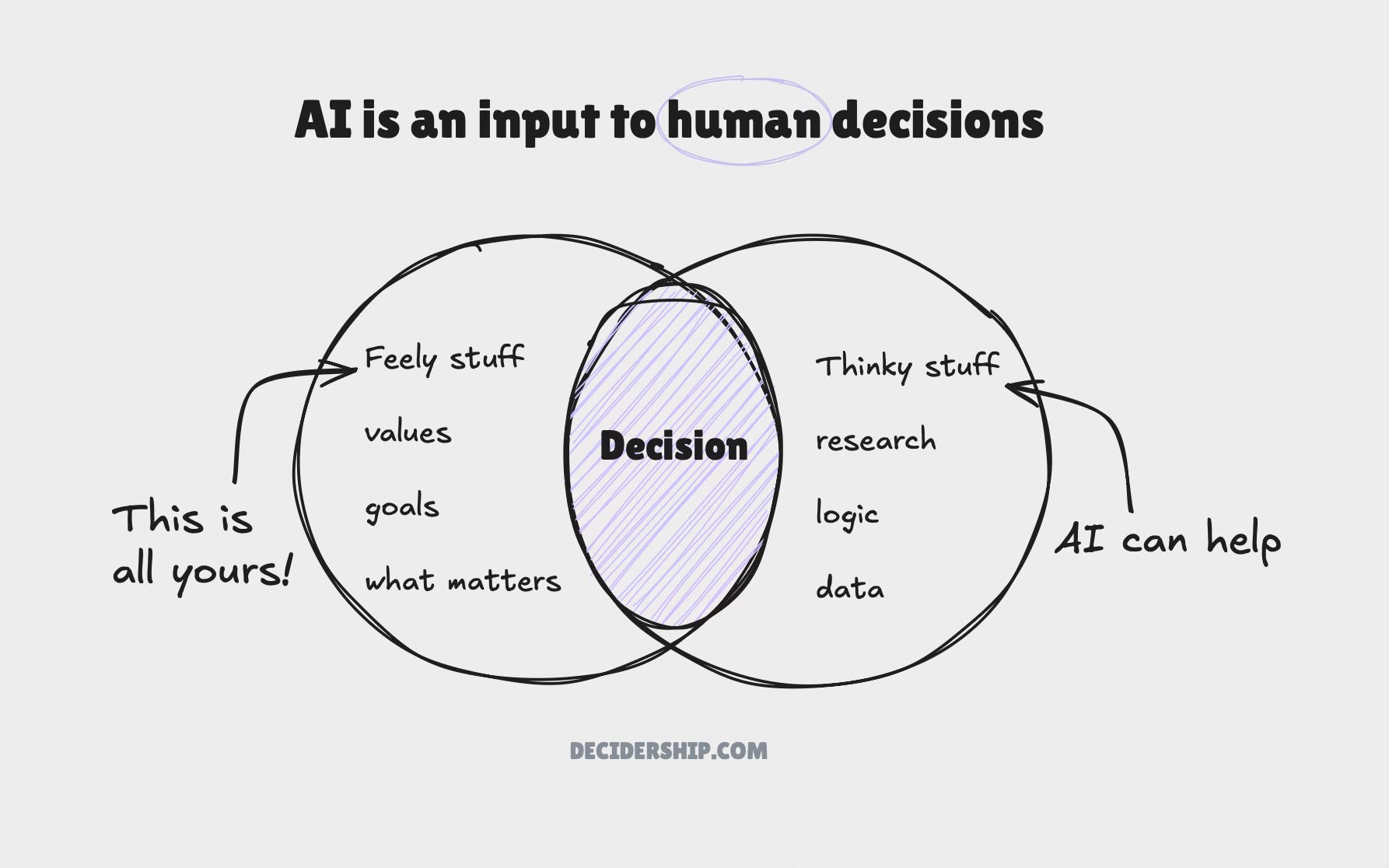
Good decisions require the full integration of thinking and feeling. The thinky stuff (your knowledge, your logic, your rationality) and the feely stuff (what you value, what you care about, what you’re afraid of).
AI can be a great input for lots of the thinky stuff.
AI can’t help with the feely stuff.
What’s dangerous is even though it can’t do the feely stuff, it will still give you an answer. A confident, well-structured, plausible-sounding answer. It just won’t be an answer that can substitute for your own answer. Even if you give the AI enough context, it is not you.
Only you can say if that output is actually useful for moving you towards your goals. You are the one who has to make the decision.
People who use AI well understand this. They don’t ask AI what to decide. They bring it in to improve thinking they’ve already done. To help them with how to decide. The AI comes in after you’ve already done some human work.
The human work is understanding your goals and values clearly enough that you can determine what will make your life better. This is the one skill AI can’t replace. I think the best way to build this is through reflection.
Every decision you make without clarity about your goals is essentially a guess. You might get lucky and end up where you want. But you have no reliable way to know whether the choice you are making is actually moving you toward your goals.
Deliberate reflection can help. The more you reflect on your goals and your choices, the better you become at thinking critically about what you want and estimating the likelihood something will get you there. The more you do this, the more you increase the chances that your next decision will get you closer to where you want.
AI will be significantly more useful to you if it is working in that context.
Here is a 3-step process for how I suggest using AI to help with a decision:
Step 1: Understand What You’re Actually After
The process needs to begin with and maintain human agency throughout. You have the power to choose what you want. Without clarity on your goals, AI output is more likely to reinforce your biases that pull you towards the wrong things.
It helps to separate your goals into two types.
Ultimate Goals are the things valuable in themselves and are the point of everything else. You don’t want them because they get you somewhere. They are the somewhere you want to be.
Enabling Goals are the things that move you toward other goals (all the way up to your Ultimate Goals).
AI cannot decide what you should value. The decision you are contemplating is essentially an attempt to move toward goals that reflect your values (and that remains uniquely human!).
So before you bring AI anywhere near a significant decision, reflect on the question: what am I actually trying to achieve here, and why does it matter to me?
Step 2: Separate Enabling Goals from Ultimate Goals
Once you have outlined your goals, look carefully at which category they fall into. Then try to get specific about how they relate to each other.
Most people go to AI with something like: “I have a performance review, how should I approach it to get a promotion?” That is a reasonable ask but it misses context that would improve the output for you.
A promotion is an Enabling Goal. But what exactly is it enabling? A greater sense of financial stability? The feeling of being seen? The ability to do more meaningful work? More control over your schedule? Each of these points towards a different Ultimate Goal and each would produce a different answer if the AI had that context.
The practical exercise of this step will look something like this: take the decision and write down your goal in one sentence. Then ask why that goal matters. Keep doing that until you reach something that doesn’t need further justification. That is your Ultimate Goal. Everything smaller that helps you get there is Enabling. Now you know what you are actually trying to achieve, and you know what context to give AI.
When you know which Enabling Goals serve which Ultimate Goals, two things happen:
First, you can check whether you are actually chasing the right thing. You should be open to the possibility that the choice you are considering doesn’t move you toward the life you want.
Second, you can give the AI the context it needs to be useful. The better the AI understands your Ultimate Goals the better it can work with you to actually get you there.
For example, long-term job security may be your ultimate focus because you want to support your family. This clarification will change the output you get about your performance review. The actionable advice will move towards achieving that (e.g. using the review to demonstrate you’re worth investing in long-term rather than pushing for immediate bonuses).
This better advice could come about because you directly prompt AI in that direction or because AI can naturally infer that from the context of your goals. Either way, you don’t get it without first having clarified your goals.
Step 3: Use AI to help you understand how to decide (not what to decide)
Once you have done the reflective work, this is the right time to bring AI into the process. Work with it by challenging your assumptions and the thinking you’ve done so far:
Generate alternatives you might not have considered.
Get it to argue for every option (especially those you don’t like).
What information might be missing?
What could go wrong with your preferred option?
What might the people affected by this decision think?
What might someone with different values do and why?
And when using the AI in this way, make sure you have taken some time to educate yourself on the system’s limitations. For example, does it have the tendency to agree with you and increase the risk your existing assumptions are reinforced?
Grapple with it with great skepticism. You are not asking it what to decide. You are using it as a thinking partner to help you work out how to decide. You still have to do the work of weighing up the AI output against your own goals and appetite for risk.
The people who make the best decisions using AI are those who know themselves enough to use it so it increases the probability they will reach their goals.
That starts with knowing what you want.