
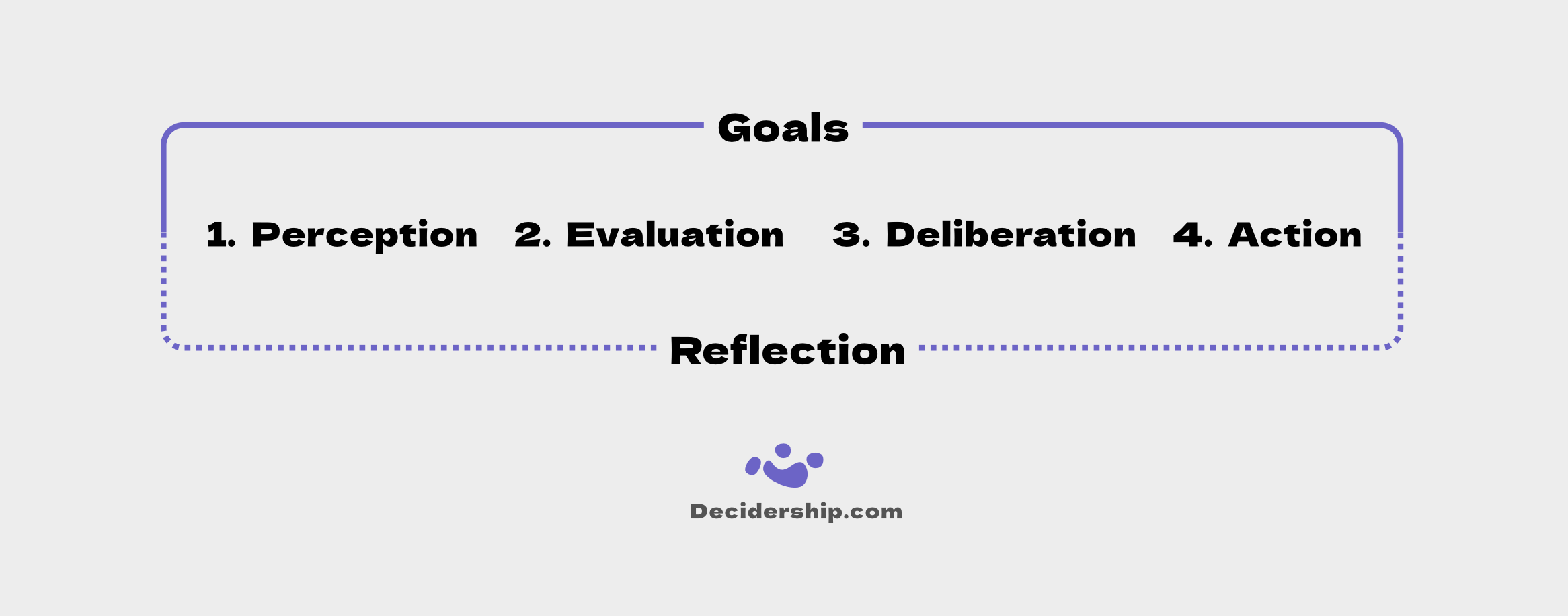
The only thing you can control is the quality of your decisions. The process that takes you from perceiving a problem to doing something about it. Most bad decisions are a failure of this process. To make better decisions you need a better process, but you can’t fix what you don’t understand.
This page is my attempt at some organisation. Having a basic decision framework can help protect you against the many ways decisions go wrong. What follows is my personal framework for thinking about decisions. It blends ancient Chinese philosophy, which I studied during my years in China, with behavioural science, which I later applied in my career. It is the most useful way I have found to think about the decision process. I have had great success using it myself and using it with other people. The more your decisions follow this kind of process, the better your outcomes are likely to be.
The short version:
Heart-Mind: Everything you think and do is a combination of your heart (the feely stuff) and your mind (the thinky stuff).
Goals: Every decision happens within the context frame of your goals.
Perception: A specific decision process begins the moment you notice a problem or opportunity.
Evaluation: You then define the decision by finding out what you know and what you value.
Deliberation: You generate options and work out which one gives you the best chance of reaching your Goals.
Action: You commit to the best option through taking action.
Reflection: You become a better decision-maker by consistently asking yourself questions about your Goals and decisions.
The full version:
Heart-Mind

One of the biggest things I took from my time in China was how differently emotion and reason are treated in Classical Chinese thought. In ancient Chinese, xin (心) is best translated as heart-mind, a single faculty that felt, thought, and valued all at once. Knowing something and caring about something are two parts of the same thing.
This seems to me like an accurate description of what it means to be human.
I think the human brain is best understood as a general purpose tool. And decision-making is a general purpose activity. You have the ability to think about and decide between inherently incomparable inputs by converting them into a single internal value scale. For example, you can decide if you would rather have an extra 500 dollars per week or an extra hour with your family per week.
We don’t have multiple systems of reason and emotion that work independently. Rational thinking never happens in isolation. It is always shaped by your emotions, motivations, and relationships. It is a mistake to draw such a sharp line between thinking and feeling, and treating emotion as the problem side. Humans are emotion and reason, not error and reason.
Humans make decisions. Any useful decision-making framework has to match how humans actually work. To be human is to be, at all times, shaped by both your heart and your mind. How you feel about something is actually relevant input in the decision process. Emotions are not obstacles to clear thinking. They are what make clear thinking possible in the first place. Our emotions set the frame for how you think and solve problems. They determine which questions you even think to ask, and which goals feel worth pursuing. A good decision requires both your head and your heart to be part of the process.
So emotions give you real, useful data about what you value and how your decisions are going. But like any data source, they can also mislead you. Good decision-making comes from properly integrating your emotions with rational thought. Keep asking yourself: are my thoughts and feelings both playing an equal role here? Things tend to go wrong when one dominates the other.
Goals

Every decision is an attempt to move you from where you are to where you want to be. Everyone has goals: a fulfilling career, security, good health, strong relationships. From the perspective of decision-making skill, your decisions are only “good” or “bad” based on the likelihood they move you towards your goals.
Because goals feel like a destination, it’s tempting to think of them as separate from the process. You think, you decide, you act, then you ask: did I hit the goal? This is intuitive. It is also mostly wrong.
Your goals are the context frame for all decisions. Goals sit above and around the entire decision process, filtering what seems worth noticing (Perception), what information seems relevant (Evaluation), which options seem worth pursuing (Deliberation), and what you are willing to commit to (Action). You are always deciding within the context frame of your goals.
It is useful to distinguish between two kinds:
Ultimate Goals: these are things valuable in themselves. Meaning, security, happiness, connection. They are the point of everything else. You do not want them because they get you somewhere; they are the somewhere you want to be.
Enabling Goals: these are the things that move you towards your Ultimate Goals. Money is the obvious example. Nobody really wants money for its own sake. They want what money makes possible: security, freedom, options.
You should be able to state your goal in one sentence. The goal should also be specific and tied to Action. This is so you can know when they have been achieved. Vague goals produce vague decisions which produce vague outcomes.1 At that point you are just lost.
You should also be able to clearly differentiate between your Ultimate Goals and Enabling Goals. This includes being able to articulate how they relate to each other causally. Get clear on what you actually value most and try to build a coherent order of goals from that. When your different motivations know their relative place in that structure they will be more likely to work together rather than against each other.
A surprising amount of bad decisions come down to mixing goals up. It is possible to spend lots of time and effort chasing an Enabling Goal you have mistaken for an Ultimate Goal. Think about the last time you achieved something you desperately wanted and felt underwhelmed.
Reflecting carefully about your goals is one of the most important parts of making good decisions. It is the main tool for making your goals explicit and you are more likely to achieve explicit goals than subconscious ones. When you get clear on your long-term foals, it gives your emotions something coherent to appear around. Without that clarity, your emotions are more likely to reinforce your biases that pull you towards the wrong things.
Working out what you truly want isn’t as simple as following your gut or listing your preferences. You attend to everything that matters to you: the feely stuff and the thinky stuff (the heart-mind). A good decision-maker isn’t simply someone who makes a lot of good individual choices. It is someone who has a coherent sense of who they are, where they are trying to go, and makes decisions that move them closer toward that.
Running example: Throughout this page I will use a single worked example to show how the framework operates in practice: pursuing a fulfilling career. I hope it is broad enough to generalise across other kinds of decisions while remaining specific enough to be useful.
A fulfilling career is, for most people, an ultimate goal. But it lacks definition so the enabling goals might vary enormously: a promotion, a job change, a complete retraining into a different field. Each of these might be the right enabling goal. Or none of them might be.
1. Perception

There is no decision to make until you have first noticed something that requires one. Perception is the start of the process for a specific decision.
You cannot possibly attend to everything, so you attend to the things connected to what you value and care about. What you notice is the product of who you are, what you have reflected on, and what you have cultivated over time. In other words: your Goals structure your perception.2
Guided by your goals, you will notice something that kicks off the process for a specific decision. That something is either a problem (something potentially bad) or an opportunity (something potentially good). I will refer to these as Something throughout. Partly for convenience, and partly because the difference is can be unclear at first. The same Something can be either, depending on your goals and how you look at it.
Perceiving Something can happen:
actively (you go looking for a problem to solve or an opportunity to take advantage of); or
passively (Something arrives and demands your attention without any effort on your part).
Humans are not neutral receivers of information. We perceive things with implications already attached. When you hear a knock at the door, you don’t hear an isolated sound.3 Your experience is that the sound came from somewhere and requires a response. Who is it? Do I answer? Cause, effect, feeling, and intended action are already built in. In this sense, we are always deciding.
Once you’ve noticed Something, a second question follows: how much attention does it actually deserve? You have to decide how much mental energy to give it. This can be done automatically and unconsciously if the Something has a very obvious interaction with your goals.
If done consciously, then this allocation is itself a kind of mini-decision, and like all decisions, it can be made well or poorly. Treating everything as important leaves you stretched too thin. Treating nothing as important means you miss everything.
Your emotions that appear when you notice Something carry real information worth paying attention to. Negative emotions can be a signal that something is pulling you away from your goals. Positive emotions can be a signal that you are moving in the right direction. The decisions that matter most for your life will often start from emotions, not abstract rationalising about what you want.
In summary, Perception is where you notice Something and decide whether it’s worth moving further through the decision process.
Our running example: Nora is a data analyst, 26 years old, living in London, with the ultimate goal of a fulfilling career. She has been feeling dissatisfied with her current role for a while now.
One Monday morning she is scrolling through a backlog of unread emails when she notices one from a recruiter. She opens it immediately. Her colleague Kevin, satisfied with his career, received the same email but scrolled past without a second thought. Same message, two entirely different perceived realities. Their goals filtered identical information into completely different decision possibilities.
Now imagine both their managers get fired. Kevin might perceive a problem: this could bring instability to his situation. Nora might perceive an opportunity: this could be a chance to have a more fulfilling career. The decision process that follows will be different because they attach different meaning to the same facts.
2. Evaluation

Once you have perceived Something, you then need to define the decision to be made. This involves clarifying the scope of what is in your control and removing irrelevant factors. This kind of Evaluation ensures you are answering the right question. It is better to make a mediocre decision about the right question than a good one about the wrong question.
Two questions structure this stage.
What do I value? (Heart): This requires looking inward and can’t be outsourced.4 You must be honest about who you are and what matters most. What is important to you? This is determined by your goals and personal values. Similar to what was said in Perception, pay attention to the signal your emotions are giving you.
What do I know? (Mind): This is largely an external question, about facts, data, and the nature of the situation. Look at a range of unbiased sources. This also includes identifying what you do not know. Answering this question can reveal things that improve your chances of a good decision: missing information, people you should consult, or the recognition that what is in front of you is a symptom of a deeper problem.
Your biases will make fact-finding hard and your values can often pull you in opposite directions. With your emotions in particular, they are crucial data points but like any data source they can also mislead you.
Your best weapon against this is training good cognitive habits and reflecting on the situation5: testing your knowledge against what you do not yet know (what remains uncertain and what assumptions am I making?) and aligning your values with your goals (does this actually move me toward where I want to be?).
In summary, Evaluation is where you start defining the decision by reflecting on what you value (heart) and what you know (mind).
Our running example: Nora opens the recruiter’s email. It is for a senior data analyst role at a tech company in a neighbouring town. It would give her a better title and better money.
She starts with what she can easily know. She looks up the company on employee review sites. She researches salary norms for similar roles. She thinks about who in her network might know something useful about the company. Her reflection highlights what she does not know: why her manager was let go, what the culture at the new company is like, whether she would need to move, whether the job would be fulfilling.
Then she turns to what she values. She assumed she wanted to earn more. Reflecting on this, she senses money might not be the most important thing. What she values is feeling competent, working on problems that feel meaningful, and not spending Sunday evenings dreading Monday morning.
Nora has realised she does not know what is wrong with her current role and what she would need a new role to provide. The Evaluation stage is helping her identify these gaps and put structure on the potential decision.
3. Deliberation

Everything else has been preparatory: perceiving Something, calibrating how much attention it deserves, establishing the relevant facts, clarifying your values. Deliberation is where you use this to work out the best way to meet your goals.
Deliberation has two steps:
Exploration: the work of generating options.
Judgement: the work of analysing which option is best.
Try to generate multiple (minimum 3) options that are sufficiently varied. You should make sure all options can actually be executed (more on this in the Action stage below). You may find exploration forces you to dip back into the Evaluation stage to gather more information.
Try to do as little judgement as possible during exploration. There is a temptation to judge the quality of each option as you generate it, but this produces worse outcomes. You end up with a shrunken option set and you construct a case for one of the first plausible options rather than the best one available.6
Sometimes judging the best option is simple enough that you don't need much more than a cost-benefit analysis. You are choosing between pasta and a cheeseburger and you don’t like pasta. You win a raffle and can take either $10 cash or a $150 theme park ticket. The value difference is enough so you take the ticket and move on.
But most real decisions rarely offer us that kind of simplicity. Perhaps you are scared of heights. Who would accompany you to the theme park? Would you go alone? Perhaps the theme park is hours away and you don’t own a car. The best choice often becomes something that needs to be weighed against circumstance, values, your relationships, your time, and how you actually feel about spending half a day standing in queues.
Humans are gifted in that they can think about vastly different things on a common value scale. Returning to the question: Would you rather have five dollars or spend ten minutes cuddling a puppy? Your answer to that question is less interesting than the fact you can answer it. These things share no common unit. There is no puppy-to-money conversion rate. And yet you had a response, probably within a few seconds.7
Therefore, Deliberation can feel less like a calculation and more like a conversation between the available options and your whole self. The best option is the one that gives you the best chance of reaching your goals. And your goals are your goals.8
When it comes to selecting your choice, it helps to get specific about how confident you are. Rather than thinking "this is the right choice," try asking "how likely is this choice to get me where I want to be?" Putting a rough number on it, even just "more likely than not" or "maybe one in three", forces clearer thinking. It also makes it easier to reflect well afterward, because you've made your expectations explicit before the outcome happens.
In summary, Deliberation is where you use all your previous work to generate viable options and analyse the best one.
Our running example: Nora now has a clearer picture of what she knows and what she values. She starts generating options whilst trying not to do much judgement yet.
She writes down everything that comes to mind: reply to the recruiter's email, go for the vacant manager position, look for analyst roles at other companies, retrain into a different field, do nothing. Some she had an instinct to dismiss but she kept them on the list anyway.
Then she judges. Doing nothing can be dismissed: she is already in that situation and it has not produced a fulfilling career. The manager role is tempting. More responsibility might mean more meaningful work. But the Evaluation stage surfaced warning signs: her manager was fired because of a structural problem above her. Taking the role might mean inheriting a toxic situation.
The retraining option is interesting. But she is uncertain about what she would retrain into, and she can’t stomach a years-long period of reduced income. She notes this as a longer-term possibility.
She has narrowed the options down to one: a new job at a different company.
The Deliberation stage is helping Nora understand what options have the best probability of reaching her goals.
4. Action

The transition from Deliberation into Action is really about the moment of commitment. One of the misleading quirks of everyday language is that we say we have "made a decision" when what we mean is that we have finished Deliberating. But making judgement and deciding are not the same thing. Judging produces a preferred option. The preferred option does not become real until you take some action in the world.
I always find the etymology of the word decide helpful to keep in mind here. It comes from the Latin dēcīdere, meaning "to cut off." A decision is to commit to a specific path and sever all others. Notice how often people announce “we have decided to…” without any accompanying action. You can intend to do something all you like, but you are still in the Deliberation stage until you take action.
A useful test for whether Deliberation is complete: you should be able to give a coherent account of the process so far. This includes the options generated, the alternatives considered, the values weighed, the probabilities estimated, and why specifically the chosen option has the best chance of meeting your goals. You must also be willing to act. Until you act, you are still deliberating. There is a difference between extending deliberation because you have noticed a genuine issue, and procrastinating because you are not ready to commit.
The willingness to commit is what adds complication to this otherwise simple stage. We don't just do the thing we judged is best because we don't have full control of ourselves. Deliberation alone does not produce action. There is other stuff at play.
Motivation is the most obvious. You can identify the best option with perfect clarity and still do nothing. Motivation is not a rational output. It cannot be calculated into existence or willed on demand. Courage might be another, when the decision involves real risk. Or self-control, when something appealing seduces you away from your ultimate goals.
Your situation also has immense influence over what you do, often more than your intentions. Research in decision science shows that people behave differently depending on the environment they are in. The same person will act differently at home, at work, under stress, or around other people. Motivation and willpower are not always enough. You also need to shape your environment so the choice which takes you towards your goals becomes the easy choice. Think about what makes that easier or harder, then make small changes that help it become more likely.
Overall, your ability to act depends on how well you have reflected on your goals. The more you have thought through your goals, the more you believe in them, the more internal contradictions you have resolved, how you might best achieve them, the more successful your actions become.
Our running example: Nora has done enough reflection. She knows what she thinks is the best option and why it will move her closer to her goals. She now needs to action this to make the decision real.
The actions come in the form of enabling goals: updating her CV, reaching out to recruiters, doing interview preparation, applying to open positions.
It doesn’t all go smoothly. Motivation comes in waves. She feels high after a good interview, low after a rejected application. She occasionally feels the pull of the doing nothing option.
Reflection

Reflection is the act of thinking in questions. If done correctly, it has the greatest long-run impact on the quality of your decision-making. Reflection is the most valuable tool you have to improve your decision-making skill because it matches how we actually experience problems. When we’re stuck, we don’t immediately reach for a rule. We wonder. And we do it more or less constantly.
Think about what your inner life sounds like on any given day. You wake up and the narration has already begun. Planning, worrying, replaying. You can’t find your phone and you will literally ask yourself where did I put it?. Your daily life is an endless question-and-answer broadcast. Reflection is about leaning into this and using it to improve your decision-making.
There are three kinds of reflection worth distinguishing.
The first is reflection on your life and goals more generally. Given how important goals are to the decision process, this kind of reflection is fundamental. Your goals are not fixed. They get discovered, revised, and abandoned through the ongoing process of reflecting. Without reflection, the context for your entire decision landscape will be wrong.
The second is reflection during each specific stage of this decision process. These are the questions you ask yourself before, during, and after, to check whether you are handling each stage well enough. If you want to learn from a decision, you have to be examining it before the outcome has had a chance to edit your memory of the process. Keeping a record of your reasoning before the outcome is known is helpful.
The third is reflection after the decision. You examine what the outcome produced and try to extract learning for future decisions. This is where the record of your decision process gives you immense value. If we reflect on that, we obtain understanding. If we do not, we will not.
This third type is the hardest, because outcomes in the real world are messy. The goal is to distinguish between outcomes that reflect a genuine error in your process and outcomes that are the product of luck.
Not everything that goes wrong means the decision was poor.
Not everything that goes right means the decision was good.
Sometimes the process was as good as it could have been and the outcome was bad because that is what probability looks like in an uncertain world. You can't control luck.
Good reflection might be asking questions such as:
Did I perceive the right Something?
Did I give it the right amount of attention?
Did I identify the relevant facts?
Did I weigh my values honestly?
Did I generate enough options?
Did I judge the best option correctly?
Did I ask the right questions?
Did I adequately consider other people?9
Reflection is also heavily neglected. Either because the outcome was good and we assume there is nothing to examine, or because the outcome was bad and we would rather not revisit it.
When done consistently, reflection will directly improve your future decision-making. Reflection gives you a distillation of what works. Every future decision you make can start from a more advanced position if you have updated your beliefs from reflection.
Reflection is how you take every decision and use it to become a better decision-maker than you were yesterday.
Our running example: Three months later, Nora has accepted an offer. Senior analyst role at a different company with a meaningful pay increase. After she has settled into the new role, she sits down and reflects.
The hours are longer than she anticipated and the boundary between work and the rest of her life has become harder to maintain than it was before. She notices that this matters to her more than she previously realised.
This is useful information. Her understanding of what the goal of having a fulfilling career means has been updated: work-life balance is something that needs to be more explicitly considered in the Evaluation stage.
Nora is also realising that she dismissed the retraining option too quickly. The feeling of losing income never really allowed her to consider the option seriously.
The next time Nora makes a similar decision she can start from a slightly more accurate picture of her values and what her goals look like and what kind of decision-process is more likely to help her achieve them.
Thank you for reading.
If you want to think more carefully about how you make decisions, this newsletter is free. Every Monday morning, something short to help you start the week deciding a little better.
Vague relationships with goals and how decisions relate to them is a common failure of many companies.
A good example is the famous research by Christopher Chabris and Daniel Simons where viewers are asked to count how many times players pass a basketball but they fail to notice a gorilla enters the middle of the screen (Gorillas in our midst: sustained inattentional blindness for dynamic events, Perception, 1999, volume 28, pages 1059 - 1074). It is of course interesting that half the participants missed the gorilla but it is even more interesting that those who missed it were completely certain it hadn’t been there. You are blind to what you perceive and even blind to your own blindness.
Another everyday illustration of how our goals give what we perceive value might be when you are walking round a park and you see a tree stump. Most of the time it is just a ‘factual’ tree stump out there in the world until you are tired, at which point it becomes a chair, it has properties that weren’t explicit to you when you were not tired (being something you can sit on).
The main exception to this might be if you are making a decision in the workplace where the corporate values are extremely clear and function as the primary funnel for all decisions.
Genuine and careful reflection is an important safeguard against the tendency our minds have to not wait for all the evidence before forming a view. We tend to construct the most coherent story from whatever is currently in front us, and then present that story as the situation.
The evidence in the Evaluation stage and the potential options in this Deliberation stage can arrange themselves according to your emotional preferences before you have consciously thought about anything, so try to make as much of your thinking as explicit as possible.
This example comes from neuroscientist Emily Falk. In What We Value, she points out that the brain already creates a common currency that lets us compare inherently incomparable things, taking inputs of almost any kind, sensory, emotional, social, financial, temporal, and converting them into a single internal scale. The option with the higher score generally wins.
You should always reflect on whether you are chasing the right goal. There is the goal you started with, and there is sometimes a different goal you are chasing by the end of this process. This can happen legitimately as you learn more about the situation and yourself, but it can also happen in a detrimental way as you may be tempted to substitute an easier goal for the original harder goal.
An unfairly small amount of attention has been given to other people in this framework as I have tried to focus on the individual for the sake of simplicity. However, how your decisions interact with other people is an immensely important part of decision-making. The world is mostly other people after all. Other people's goals, perceptions, values, and choices are constantly affecting you. Your decisions are always different when other people are added.