
Nobody knows what work will look like in the future. If you’re a junior professional, you are justified in feeling anxious. What should you do to future-proof your career?
I’ve read a lot of ‘future of work’ content recently (main resources linked below the article1). A lot of the reports are unfortunately quite hard to action. You only get some vague ideas about what to actually do.
Perhaps that is forgivable as the level of uncertainty is high. Nobody is comfortable making predictions about the future (especially given how society is currently working through the consequences of the past decades of conventional wisdom on what people should study).
So what should you do when there is this level of uncertainty?
Applying a decision-making lens, one sensible approach is to future-proofing your career is to do things that work across multiple futures. There are two ways to think about this.
First, make robust decisions. This is a decision that can absorb surprises without falling apart. Whatever happens, within a reasonable range of outcomes, you’re still okay. A consequence of this usually means you’re not optimising for the best case. You’re just making sure you stay in the game.
Second, preserve optionality. If robustness is about withstanding surprise, optionality is about being able to respond to it. Do things that give you the opportunity to change direction once things become clearer. This usually comes at some kind of cost. But it can often be a price worth paying, especially early in a decision path, where you know the least and a wrong commitment costs the most.
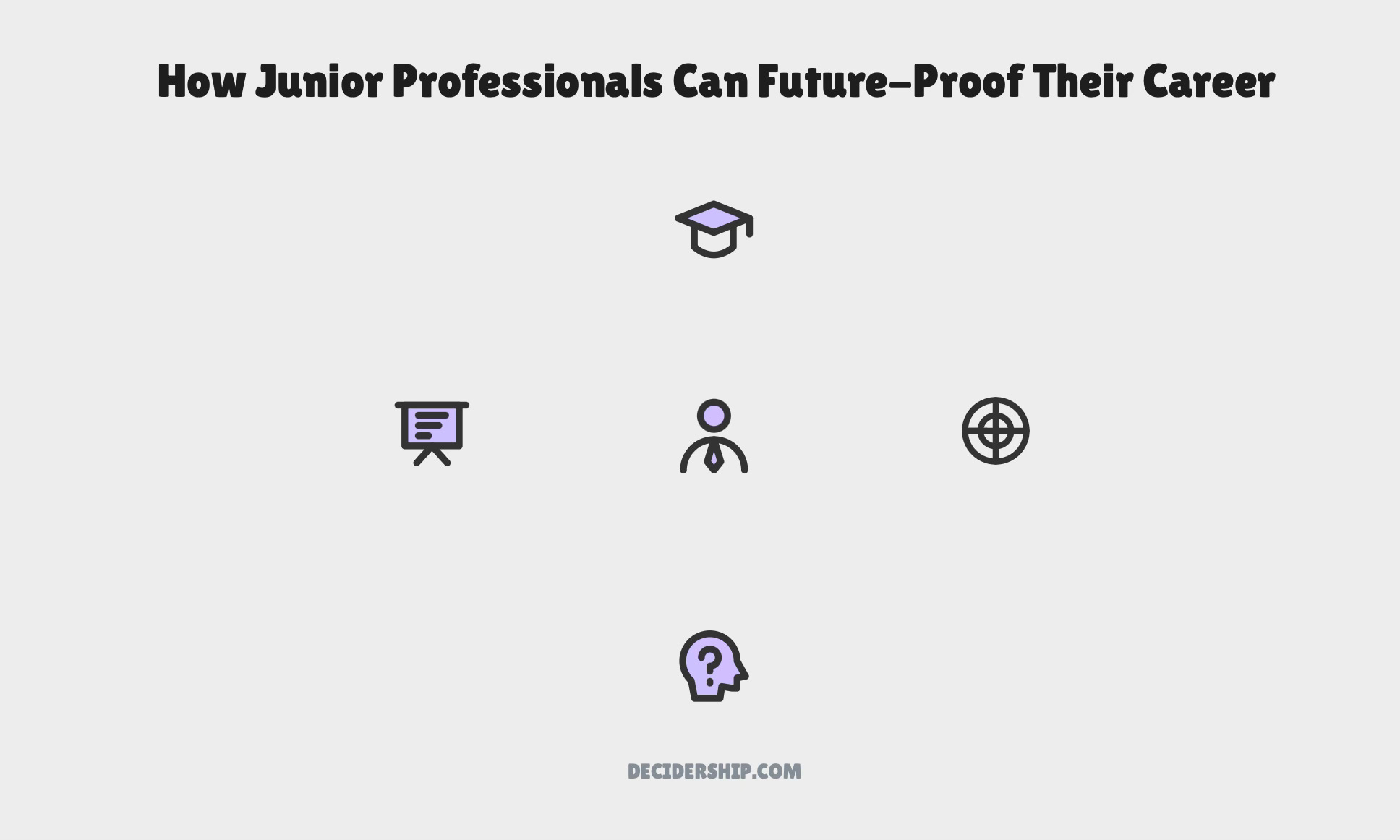
Based on the future of work content I’ve consumed, here are four skills that I think will work across multiple futures.
Improve your storytelling ability
Jobs will keep changing, but we will always need an answer for what to work on. And a good answer only matters if other people find it compelling. That requires the ability to persuade, explain, teach, sell, lead, and inspire. The vehicle that humans enjoy most for all of those is storytelling.
With information now being abundant, it might be a good idea to work on how you package that up. It is valuable if you can help other people understand what matters and why it matters. The next time you need to explain something, don’t just hand over the information. Try to give a full arc e.g. here’s the situation, the problem, what’s changing, and what could be done.
You may also benefit from studying the actual mechanics of storytelling more deeply. I would recommend checking out Will Storr The Science of Storytelling as a good place to start.
Teach others how to use technology
There is good reason to believe the gap between what technology can do and what people can do with it is going to keep increasing. If you can get good at the ‘meta-skill’ of teaching others how to use technology then you will always be valuable in a way that doesn’t depend on any specific direction of progress. Businesses will continue to need people who can be the bridge between technical and human capabilities. I don’t think the desire for human-to-human learning exchange is going to go away.
Two specific ways to start this week: (1) record (e.g. using Loom) or write a short walkthrough guide for a common tech-based workflow; and/or (2) put open office hours in your calendar where people can come ask for help on your expert area.
Teaching will also help you develop other skills. Explaining something to someone senior to you is its own kind of social/political skill. Mapping the benefit of a technology onto someone else’s job forces you to think critically about how their work really functions. And all of this might involve storytelling!
Get better at talking about data
Presenting data has long been a valuable skill, and it isn’t going away. The problem is that humans aren’t naturally good at interpreting or communicating about data.
We use imprecise words to describe likelihood all the time, and assume other people mean the same thing we do. I’d recommend doing the survey at probabilitysurvey.com. It shows how your sense of a word like “likely” translates into a number, compared to everyone else’s. I’ve run this as a workshop exercise multiple times, and people are always shocked at how wide the ranges are.
This matters more, not less, as AI produces more forecasts and predictions for us to act on. Someone still has to work out how “60%” feeds into a decision. That’s a human skill, not a technical one.
Get good at ensuring that the recipients of your data communications are interpreting as closely as possible to the truth. Two ways you can start working on this:
Use numbers, not words. Instead of “it’s likely to happen,” say something like “I’d put it at 70%.” A lot of people feel exposed when they think about doing this. Or they think they are communicating an ‘artificial’ level of precision. I think it is important to remember that you are already putting a number on this in your head. When you use these words, you already have some idea what this means to you. So this isn’t actually asking you to do anything you are not already doing. It is just about making it explicit rather than implicit.
Use a reference case instead. In my experience, I still meet people who give immense pushback to using numbers instead of words. They can’t bring themselves to do it for a variety of reasons; the two most common are: (1) it would seem weird in their ‘company culture’; (2) they feel exposed communicating that level of precision (especially common from those in high-risk/compliance areas). I don’t find either of these reasons particularly good enough to avoid using numbers. However, if you must avoid using them, then consider if there is a reference case you can use instead. Find an analogous case that will resonate with your audience and use this as your way to communicate likelihood (e.g. previous cases similar to this had a success rate of 80%).
Develop intent-based behaviour
Critical thinking is a common category that comes up across these reports. The ability to think for yourself, make good judgments, and act on them. But like a lot of what’s in these reports, it’s vague and hard to know how to practice.
A practice that came to mind was “Intent-Based Leadership”.2 The idea that when you bring a decision to someone senior, you phrase it as “here’s what I intend to do, and why”. You can take this idea and apply it to your work-based behaviours more generally. Taking every problem all the way through to the point it becomes intent-based will necessarily train your critical thinking skills.
If you are used to waiting for an answer on exactly what to do on every task, you won’t be ready when the context changes.3 You’re not building any transferable skills. But the skill of assessing a situation, forming a judgment, and proposing the action is transferable. So in the context of preparing for an uncertain future, developing this intent-based behaviours passes the robustness test.
This ones easy to start practicing immediately. Next time you take a problem to your manager, structure it as “here’s what I intend to do, and why.”
I don’t know what work will look like in the future. Nobody does. But this is my best guess at what you can do to put yourself in a good position no matter what happens.
You can learn more about this by reading the book Turn the Ship Around or going to the website here.
A similar concept is that of having ‘high agency’. Unfortunately, a significant amount of writing on this topic is incredibly frustrating. I personally don’t find it helpful. You only get a vague intuition for what people mean and very few concrete applications. Cate Hall is one of the better writers and her Substack has good specific examples.
Great piece! Would you mind giving an example on the "here's what i tend to do and why" thing mentioned at the end please?
I'm a little bit confused about what you mean and how it would be structured in reality, since the piece mentions both "taking a problem" and "bringing a decision" to someone senior, and they seem like they might be slightly different things?