
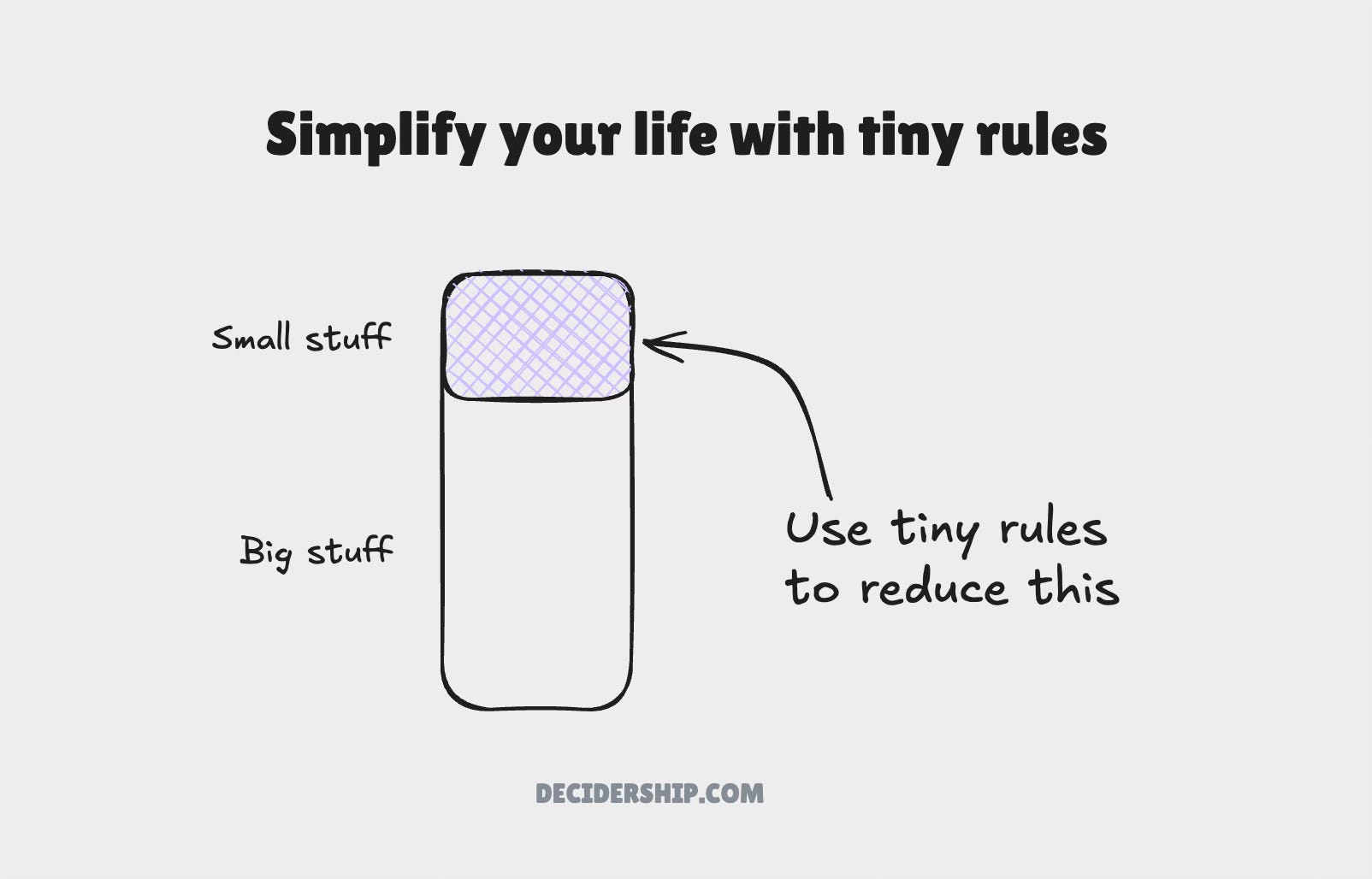
There is a Chinese idiom “鸡毛蒜皮”. It translates approximately to ‘trivial things like chicken feathers and garlic skins’. The origin is from a story about two neighbours. One raises chickens; the other sells garlic. When the wind shifts, chicken feathers drift into the garlic seller’s garden. When the wind shifts back, garlic skins blow the other way. A dispute breaks out. It escalated until it landed in front of a judge, who dismissed the case as too petty to bother with.
The judge did what neither neighbour could: recognised that some problems aren’t worth solving.
Many of us are more like those neighbours than we’d like to admit. It can be embarrassing to admit just how much of our mental energy goes to exactly this kind of thing. The trivial, low-stakes, mildly irritating decisions that pile up like garlic skins on the wrong side of the fence.
To admit this fully, we also have to acknowledge the fantasy version of our lives: if we could just clear away all the petty small stuff, we’d have unlimited bandwidth for the decisions that actually matter. We would be full of vitality ready to make progress on what we want.
It’s a lovely fantasy. It’s also wrong in at least three ways:
First, the trivial decisions never go away. They’re infinite. You solve one petty thing and two more appear. That’s just nature.
Second, sometimes the small stuff is the real stuff. Small things left unsolved can often compound into bigger issues. Or sometimes the small stuff is necessarily linked to the bigger picture. If you can’t sell your garlic because it’s covered in chicken feathers, then it might not be so trivial.
Third, those big decisions you’re longing to get to? You’ll complain about them too. They only look appealing at a distance because the small decisions are so immediately annoying. The grass isn’t always greener on the other side of your to-do list.
So, how should we deal with small decisions?
I came across an idea from Adam Grant called personal policies.1 It is a pre-determined list of things he does or doesn’t do. Adam gets asked to do lots of things: blurbs, advice, introductions, collaborations. Individually, these requests are reasonable. Collectively, they could consume his entire life. Personal policies allow him to have a rule that applies when he receives these one-off requests. For example, has he been given two months’ notice? If not, then the answer is no.
I find the logic behind this useful. By converting a small decision into a personal policy, he gets to stop spending energy on it. I stole the skeleton of that idea and applied it more broadly.
You should start creating Tiny Rules.
A Tiny Rule is a pre-made decision. A small, practical instruction to your future self: when this type of thing comes up, do this.
Here are what some might look like:
Reject caffeine after 5pm.
Always take the stairs if it’s three floors or fewer.
Never accept a meeting without an agenda.
If a task takes less than two minutes, do it now.
Always sleep on a purchase above a certain threshold.
When I share this idea I often get pushback: isn’t it bad process to deliberately build a system you know will produce suboptimal decisions? I struggled with a response to this for quite some time. It is a fair and intuitive point. I have two main arguments for the benefit of Tiny Rules:
First, your decision-making life is a portfolio. You make thousands of choices competing for the same finite pool of attention, time, and energy. It is wrong to evaluate each decision solely as a self-contained event. Accepting an individual suboptimal outcome to get more bandwidth elsewhere is a positive expected value move. Tiny Rules produce better outcomes cross your whole decision-making life.2
Second, everyone has to start somewhere. For certain people, Tiny Rules are a good entry point for improving decision-making. Get Tiny Rules in place first. Once you have more structure to your decision-making you can revisit Tiny Rules and make them more optimal. I have had success in getting people started on a behaviour change journey through using Tiny Rules.
You don’t need many. A handful of well-considered Tiny Rules, applied consistently, can do a surprising amount of work. Here is a rough framework for identifying when you might want to use a Tiny Rule:
Is this a recurring decision? Creating a Tiny Rule makes sense for things that come up repeatedly.
Is there limited downside? Tiny Rules should apply to low risk situations.
Does this deserve my time? Tiny Rules gain the most value when applied to decisions that should be made quickly.
Is the area well understood? Tiny Rules work best where you have enough experience to know what a good default looks like.
Does it strongly relate to emotion? It might make sense to let Tiny Rules take over if emotion is likely to make you choose poorly (e.g. you’re tired, hungry, or angry).
If a decision passes most of those tests, you’re probably safe to make it a tiny rule. I would suggest writing it down because there will be a temptation to re-examine each decision when it comes up. Resist that!
You can start spending more time on what is important to you by using Tiny Rules.
This relates to my broader idea of ‘meta-expected-value’. The idea of applying the principles of probabilistic thinking and expected value in a holistic sense to you as a decision-maker. Humans make decisions. Humans are finite, bounded, and fallible. Striving for ‘optimal’ should be considered in that sense.