
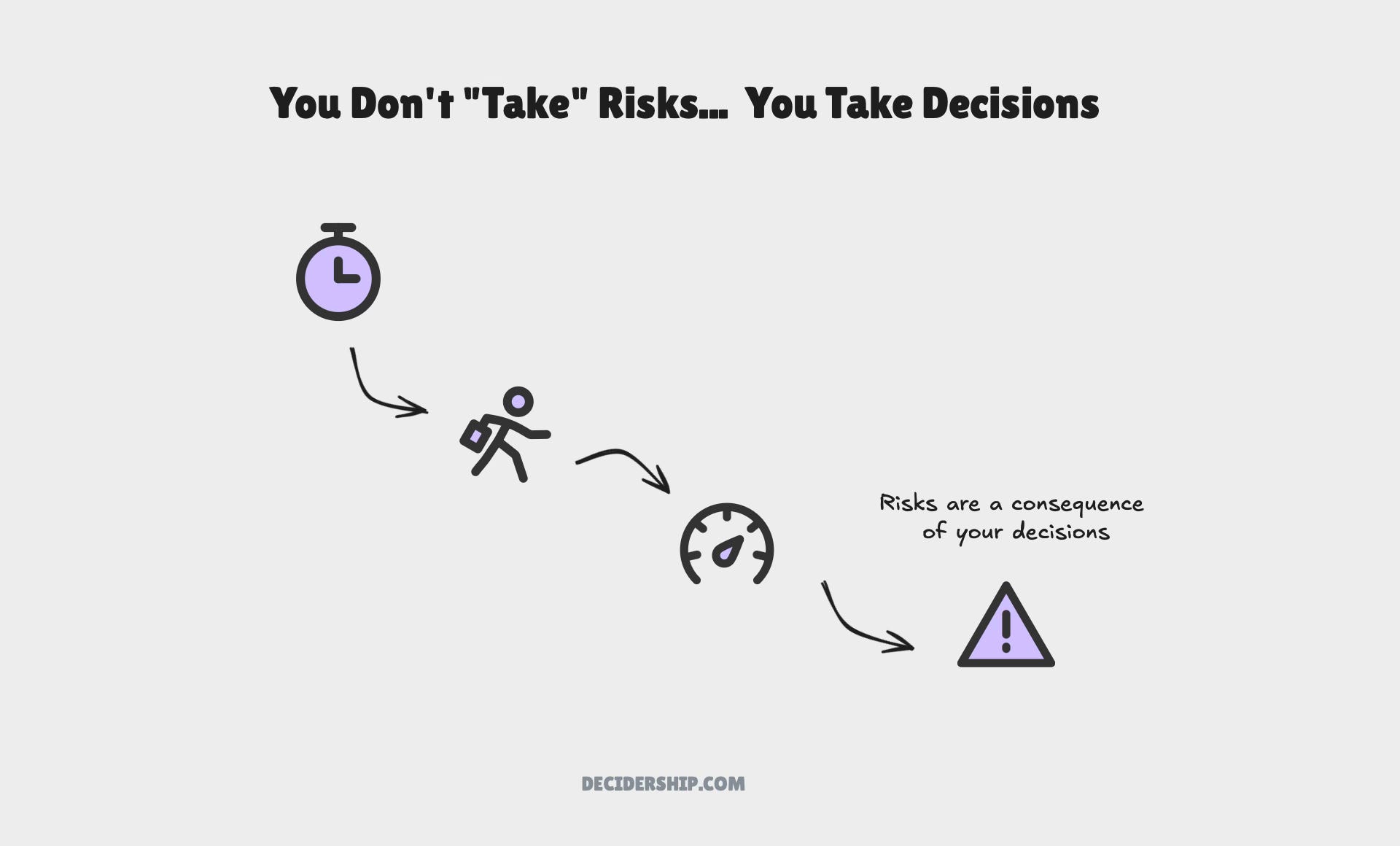
I struggle with the phrase “taking risks.” Risk can mean many things and it is usually a subjective concept, so you often need to ask questions to clarify what someone actually means by it. Yet people say it constantly and everyone assumes they are on the same page.
In my view, we don’t wake up and set out to “take risks”. What actually happens is we take a decision in pursuit of the things we want, and risk shows up as a side effect.
That’s why I find conversations about risk are more productive when they start with the goal.
Let’s say your goal is to get to work as quickly as possible because you have an important meeting. You might decide to drive faster than you normally would. The increased chance of an accident isn’t something you set out to get. It’s the consequence of optimising for the goal of speed.
So risk isn’t really something sitting out there in the world. You can’t pick it as an ingredient for your decision. You can only pick from the actions available to you, and each one comes with its own set of possible outcomes and consequences attached. Risk, however you define it, lives in those consequences and the uncertainty of how they relate to your goals.
Take our speeding driver. Imagine they pass a stretch of road marked with police tape, flowers, photographs, a sign that says “Father.” They might slow down after this. I don’t think saying they are “taking less risk” is the most accurate description of what is happening. What changed is which goal is being actively pursued. The goal of staying alive has replaced arriving on time. The slower driving is the decision in pursuit of that new goal.
This explains a lot of disagreement about risk. Two people can look at an identical set of facts and disagree about how “risky” something is. Part of the problem is that “risk” is an incredibly hard word to pin down. People use it assuming everyone else means the same thing.
That’s why the phrase “taking risk” can be unhelpful. It jumps too far down the decision process, leaving a lot of crucial information about perceived negative consequences implicit. Often, when you explore the disagreement further, you realise people actually just disagree about the goal or the best way to achieve it.
Talking about decisions and goals instead of “taking risk” allows us to bring those concerns into the open. We can more precisely understand exactly what uncertainty and harms we are referring to when we talk about “risk”. Then we can have a sensible discussion about our attitude towards that:
How much harm are we willing to accept in pursuit of our goals?