
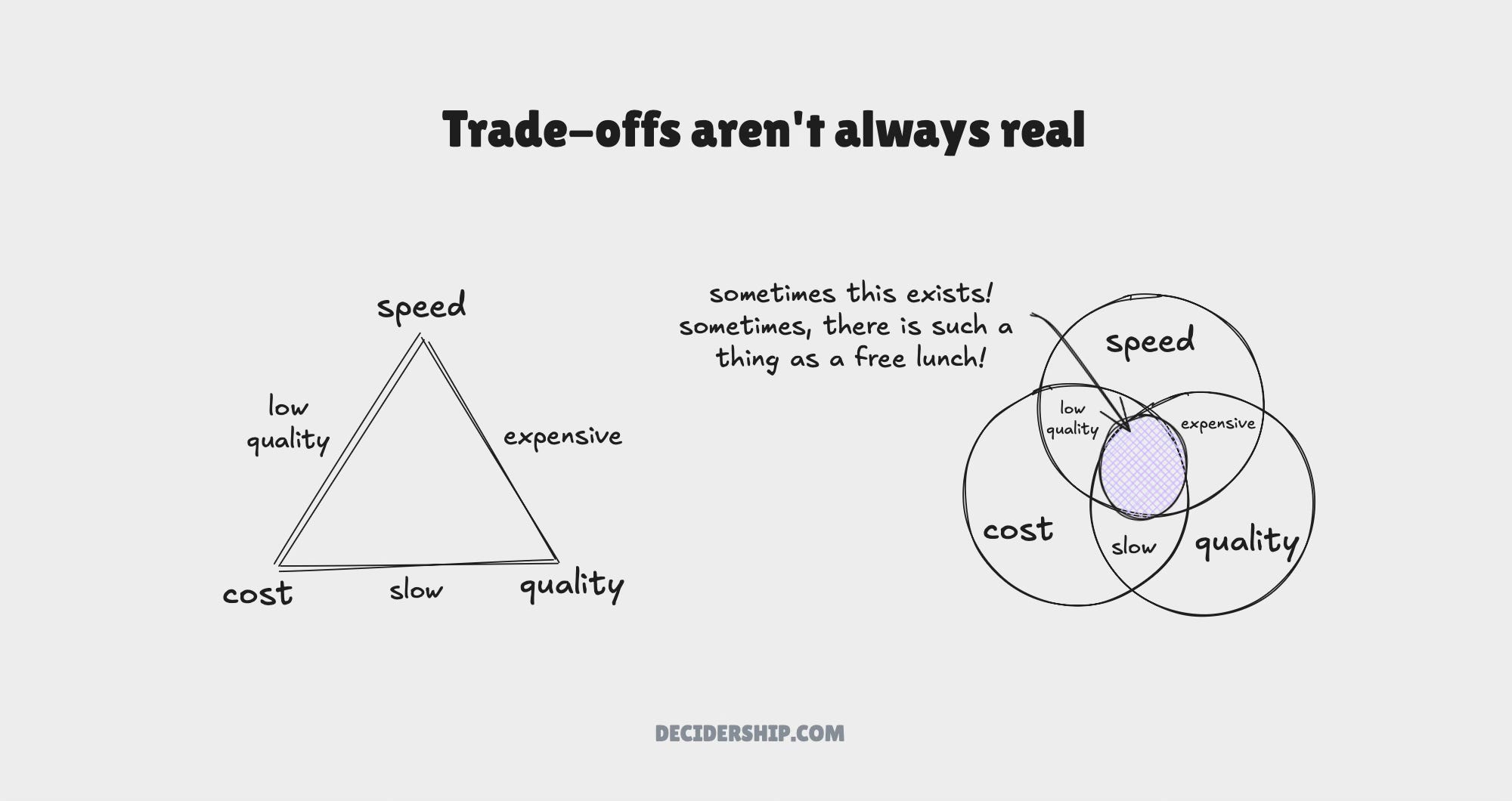
Some beliefs are so embedded in our thinking that they become the assumed conditions of doing things. A bit like how we never think about gravity. We just operate within its constraints without a second thought.
This week I want to talk about one of these beliefs that underpins almost all our decisions. When two things you want are in tension, one of them has to give. More of A means less of B. There is always a trade-off.
We frame all decisions as a negotiation between gains and losses. “Which part of what I want am I willing to sacrifice?”. But this should be a conclusion you’ve reasoned to rather than an assumed starting point. This assumption prevents you from properly Deliberating about a problem because you've narrowed your option set before you've done the work of exploring it with an open mind.
The assumption of trade-offs is consistently reinforced from different domains. It’s been foundational to much of economic theory. We see it in nature by looking at the different ways animals have evolved by trading off features to survive. And we are constantly reminded of it at a cultural/societal level when “there’s no such thing as a free lunch” is stated with the authority of a natural law. So I think it is entirely understandable how even excellent decision-makers accept the framing that you can’t have it both ways.
However, this is a case where the perceived wisdom is not entirely true. Trade-offs are not a fundamental law of decision-making. Sometimes, trade-offs are avoidable. Sometimes, you can have it both ways.
Australian economist Nicholas Gruen wrote an article exploring how economics is often framed as the study of trade-offs. It is so central that it’s rarely questioned. This causes better solutions to stay hidden. Gruen references Toyota disproving the assumed trade-off between cost and quality. Toyota designed production systems that got things right the first time. Traditional manufacturers focused on fixing errors after the fact, which was both more expensive and less effective. Toyota improved quality and cut costs simultaneously.
IKEA might be another example. A long-standing industry assumption that cost and aesthetics were trading off against each other. Cheap furniture must be ugly. Perhaps IKEA showed this was less of a trade-off and more of an independent design problem that could be solved.
So a lot of the work decisions we face today are removed from natural conditions. They’re not bound by the same zero-sum logic. The modern corporate world, in particular, is not “real” in the same way the natural world is. The business decision space is more “constructed” rather than “determined”. It is a positive-sum game. The constraints of many business decisions can be changed or circumvented in ways that natural constraints cannot.
Even the binary framing (trade-offs being between two things) is a simplification. In practice, trade-offs rarely present as a simple sliding scale between two things. More often, you’re dealing with a web of variables all pulling in different directions at once. Time, cost, quality, convenience, etc.
So this week I encourage you to be skeptical of every trade-off you encounter. Question whether it is real. Spend a moment to think about whether there is a way to solve the problem with less sacrifice.
One technique you might want to try is what’s sometimes called “constraint relaxation”. This is asking what you would do if the constraint simply didn’t exist. What would the ideal solution look like if you couldn’t fail? Sometimes a better solution can be found in an idealised scenario. Or at least the thought exercise might point you in the right direction.
Most of the time, you’ll indeed confirm that the trade-off is real, and proceed accordingly. No harm done by checking. But sometimes, you might just get a free lunch. The only way to find out is to stop assuming you can’t.
Hi Nick, Just wondering if you have any thoughts on Limitarianism? Ingrid Robeyns wrote a book about it, Limitarianism: The Case Against Extreme Wealth. Do you have any thoughts on how Limitarianism might be successfully implemented?