
I have been working on decision-making for over a decade now. I spent years at university researching it and chose my career because of my passion for it. A few years into that journey, I wanted to move beyond theory and try something I could actively experiment with. A real competitive environment where I could test whether these ideas actually worked. In 2019, that search led me to Fantasy Premier League (FPL).
Now, seven years later. The results have been great (or very lucky!). Over the past four years, I have the best rank out of 10+ million people who play.
There is a tendency to assume you do well in fantasy sports by knowing more about sports and data. I don’t think that is the case. I didn’t really know anything about football when I started. I believe what matters most is the quality of your decisions.
I have written about decision-making more generally (e.g. personal life and work) in my framework, which you can read here. This article is a more personal account, an exploration of what seven years of competitive fantasy sports have taught me about decision-making.
Fantasy sports are, on the surface, an incredibly silly hobby. But it is a very instructive laboratory for decision-making. If you have never played fantasy sports, don’t worry. This piece is about what it reveals about how we make decisions.
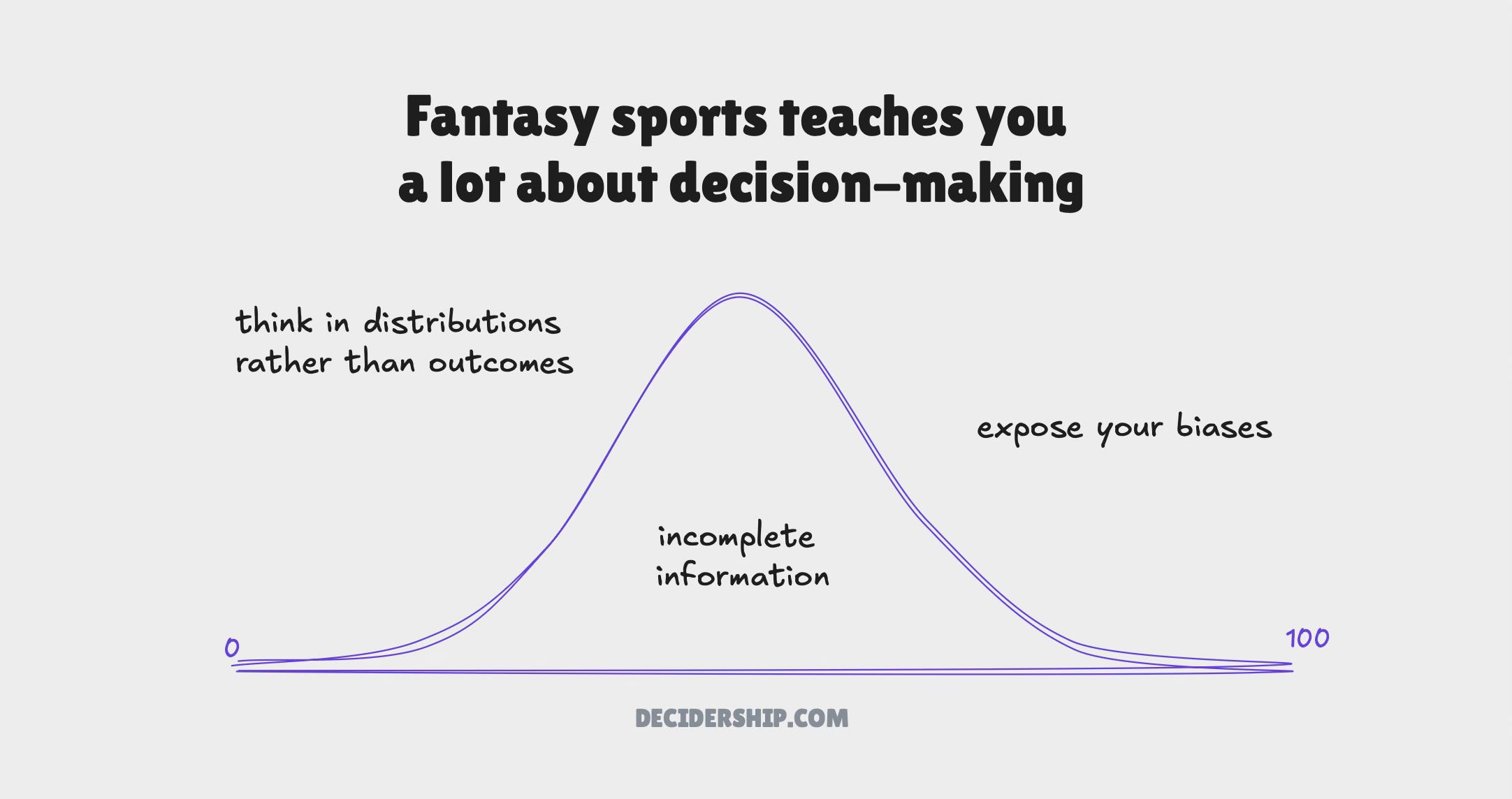
Incomplete Information
It is difficult for us to shake the assumption that good outcomes mean good decisions. In systems where information is complete and luck plays little role (e.g. chess), that is true. But activities like fantasy sports, poker, investing, real life, are not like that.
You never have all the information. You don’t know which player will get injured, which team will get a penalty, which player will get a red card. Playing fantasy sports is similar to picking stocks: you are always deciding with incomplete information, and remote events entirely outside your control will regularly impact your outcomes.
This gap between decision quality and outcome is where you learn interesting decision-skills. People who improve are the ones who understand this gap and develop a process of reflection that works around it. They spend a significant amount of time evaluating their choices independent of their results. They learn to ask not "did it work out?" but "was that a good decision given what I knew and what I valued at the time?"
Thousands of Decisions
Over a full season, fantasy sports gives you thousands of decision points. You have limited resources each week and dozens of different options available to you. Most areas of life offer relatively fewer decisions, with consequences spaced out over a longer time period. Fantasy sports compresses this. In a single season, you encounter an enormous range of decision types and get the opportunity to observe your own tendencies across all of them.
This allows you to create a "decision archive". If you document your reasoning before outcomes are known, you can start to review patterns in where you go right and wrong, and use each decision as a small data point for refining the next one. The habit of structured reflection is, in my view, the single biggest tool for improving decision quality.
Expose Your Biases
We all carry cognitive biases we are not aware of. Fantasy sports makes them visible because the structure of the game creates conditions in which they flourish. Here are a few:
Sunk-cost bias: irrational choices because of costs that have already been incurred. This shows up when you hold on to a player you are too invested in to let go of, even when the rational move to let them go is obvious.
Hyperbolic discounting: the pull toward immediate reward over better long-term outcomes. This appears every time you make a short-sighted move focusing only on this week rather than thinking long-term.
Loss aversion: the tendency to feel losses more sharply than equivalent gains. You can only own 15 players so there will always be more negative events than positive events.
Mere exposure effect: preferring what is familiar. You are reminded of this when you over-trust players you have had success with before, even when the evidence no longer justifies it.
What makes fantasy sports genuinely useful as a training environment is that these biases have immediate and legible consequences. You can trace an outcome back to a specific decision made under a specific emotional or cognitive condition. A knee-jerk decision made after a goal is scored or making choices when you are sleep-deprived. That traceability is not always available in real life. Experiencing this frequently allows you to learn a lot about yourself and develop strategies to counteract these tendencies.
Having a clear decision process you can stand behind is an antidote to a lot of this. It can give you ‘decision sanity’. When you have documented your reasoning in advance and you understand what was luck versus what was your own judgment, a bad outcome loses much of its power over you. You can look at what happened and assess it rationally rather than react to it emotionally.
Thinking in Probabilities
Fantasy sports force you to make decisions under uncertainty. You can't find certainty by delaying, procrastinating, or hedging. Every week you have to commit to a choice before the deadline.
This trains a particular kind of thinking that is enormously helpful in life: thinking probabilistically. You have to get comfortable assigning rough probabilities to uncertain outcomes. This forces you to be explicit about what you actually believe and how confident you are. What is the likelihood something will happen and how big will that impact be?
Fantasy punishes thinking in binary terms. The best decision-makers are those who learn to deal with uncertainty properly. To think in distributions rather than outcomes. To make decisions that are right in expectation even when they won’t always pay off individually.
Having good predictive data sets can sometimes give us a false sense of certainty. You still have to think about your decision. Learning to think probabilistically about your decisions is an entirely separate skill from having good data models.
Experience Is Not Enough
One of the strongest pieces of evidence that fantasy sports is primarily a game of decision-skills is that those who have played for a long time are not meaningfully better than those who start later. Experience alone does not produce improvement.
The reason is that without honest reflection, experience teaches you the wrong things. You credit wins to good thinking and losses to bad luck. You adjust your strategy based on outcomes rather than the quality of your reasoning. Experience without examining your process isn’t all that useful.
What produces genuine improvement is deliberately analysing your decisions separately from their outcomes. That means being honest enough to grapple with things you don’t want to see. Being able to label a decision as poor even when the outcome was good. When you ignore a poor decision, you give up the opportunity to extract its lesson.
Without failure there is no learning and without learning there is no improvement.
Thank you for reading.
If you want to think more carefully about how you make decisions, this newsletter is free. Every Monday morning, something short to help you start the week deciding a little better.
If you are interested in understanding about the decision process more generally, I recommend reading my decision framework.
Love these thought process articles. Lots to think about rather than just advice on teams/players.
This is great, thank you! What are your thoughts on when/how that reflection should happen in practice? One issue I often find is the 'reflection' is in a way folded in with the decision-making process. i.e. if I'm making a particular decision then I've already decided that this is the best decision given the incomplete information and therefore what is there to reflect on?
Perhaps I'm thinking about this the wrong way. Is there some useful 'gap' between decision and outcome? With FPL for example I suppose we could use the deadline (decision is made before the deadline... time passes/sleep on it, etc... deadline gone but pre-outcome < reflect here).