
Unfortunately, there are few things that are true decision-making ‘hacks’. Meaningful improvements to your decision-making takes deliberate effort (hence the encouragement here for people to work on Decidership). But there is one principle that gets quite close.
In my general decision framework, Goals are the context for your decision-making. Goals structure and filter your perception. You notice and pay attention to things connected to what you value and care about. Once an opportunity or problem is noticed, then you can start making a decision.
You can’t include something you haven’t noticed into your decision process. We have all made a decision and then found out afterwards that we had an incomplete picture. We would have chosen differently if we knew more.
Getting the right information in front of you at the right time is often the hardest part of a decision. Once you have it, the decision calculation part becomes simple. So the hard part is often organisational: arranging your life/business so the relevant info is available to you at the right time. Anything that increases the chance of getting that information early is very valuable.
Share your goals and your values with the people around you is one way to do this.1
Think about what happens after a good friend tells you they’re looking for a new job. You start noticing new things. You stop scrolling when you see a relevant job advertisement. You overhear different conversations at the office. The way you interact with the world changes.
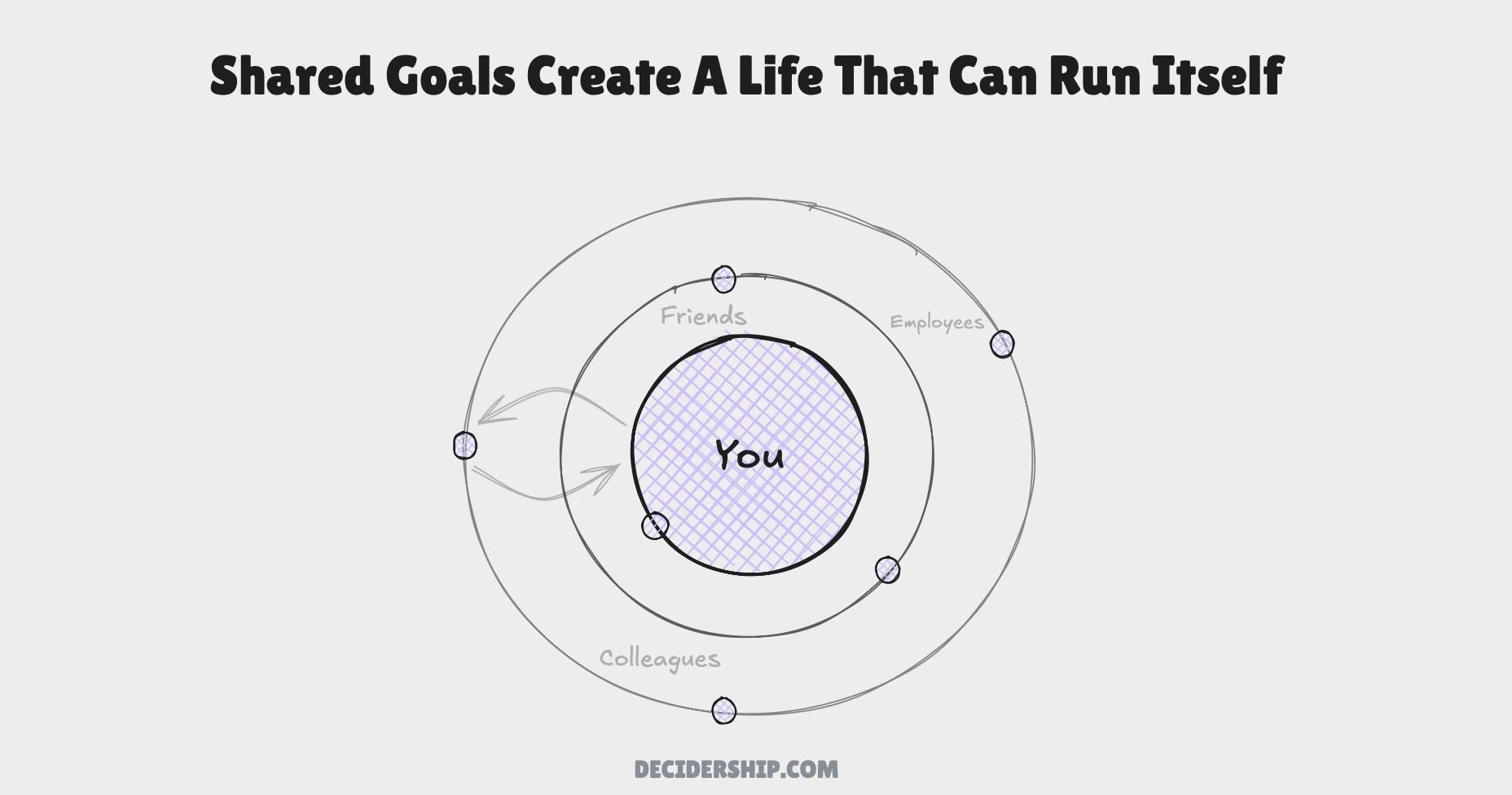
You can scale this. Every person you know is moving through the world absorbing information. They are all potential ‘perception nodes’ for you. But without knowing what you are trying to achieve they can never pass the information back to you.
I think about it as Distributed Perception: the practice of distributing your perception by turning those around you into perception nodes.
In personal life, this is just being open with those close to you about what you’re working towards. Like the job example above.
In business, this is a strong argument for sharing your corporate values. It’s easy to become cynical about internal messaging. For employees, it can seem like corporate speak, disconnected from your day-to-day job. For management, it’s easy to forget the point of company values. They can become something for optics rather than for behaviour change.
But they can encourage behaviour change. People who understand what the company wants to achieve will notice new things and act accordingly. Sales can structure deals according to your revenue ambitions. Marketing will notice relevant risks in your advertising. Teams will hire people that match the cultural values. Let people understand the destination and they will find routes without being told.
Distributed Perception requires a little structure. Here are a few principles that help it work:
Two-way: Someone else helping you with your Goals is a privilege. So, the process should also be reciprocal. You have to be willing to make it mutual. Ask the people around you what they’re working towards.
Repeatable: You shouldn’t expect your needs to stay at the top of anyone else’s mind. You should find a way to create a repeatable process where goals and values are shared.
Low friction: Distributed Perception only works if the information reaches who needs it. If people spot something relevant but don’t know who to tell then the information will get lost.
Actioned: Distributed Perception only works if people trust that their contribution matters. If they raise things and nothing happens, then they will stop. What is seen has to be acted on (or at least acknowledged).
So this week, tell someone your goals. Ask them what they value. The more people around you who know what to look for, the more likely they are to help you. And the more you know about what they need, the more useful you become to them.
Everyone’s lives get a little bit easier to manage.
If you want others to help you then there are generally two parts: (1) you need to be a capable and reliable person that people actually want to help; (2) others need to know how to help you. This article is about the second part, which I think a lot of extremely talented people forget and therefore don’t get the opportunities they deserve. (1) is not always enough.